Postingan

Menampilkan postingan dengan label GCHQ

NSA and GCHQ stealing SIM card keys: a few things you should know

Gambar
(Updated: February 27, 2015) Last Thursday, February 19, the website The Intercept broke a big story about how NSA and GCHQ hacked the security company Gemalto in order to acquire large numbers of keys used in the SIM cards of mobile phones. The story has quite some background information about how these keys are used and how NSA and GCHQ conducted this operation. But as we have often seen with revelations based upon the Snowden-documents, media once again came with headlines like " Sim card database hack gave US and UK spies access to billions of cellphones ", which is so exaggerated that it is almost a scandal in itself. Instead, analysing The Intercept's article and the original documents leads to the conclusion that the goals of this operation were most likely limited to tactical military operations - something that was completely ignored in most press reports. Also there is no evidence that Gemalto was more involved in this than other SIM card suppliers. To what ext...

How GCHQ prepares for interception of phone calls from satellite links

Gambar
(Updated: January 6, 2017) Most of the Snowden-revelations are about spying on the internet, but NSA and GCHQ are also conducting the more traditional collection of telephone communications that go through satellite links. What needs to be done before phone calls can be collected, can be learned from two highly detailed technical reports from the GCHQ listening station near Bude in the UK. These reports were published on August 31 last year by the German magazine Der Spiegel and the website The Intercept as part of a story about how Turkey is both a partner and a target for US intelligence. Here we will analyse what's in these reports, which give an interesting impression of the techniques used to transmit telephone communications over satellite links. Satellite dishes at the GCHQ intercept station near Bude, Cornwall, UK Officially, such technical reports are called "informal reports", as opposed to the "serialized reports" that contain finished intelligence...

INCENSER, or how NSA and GCHQ are tapping internet cables

Gambar
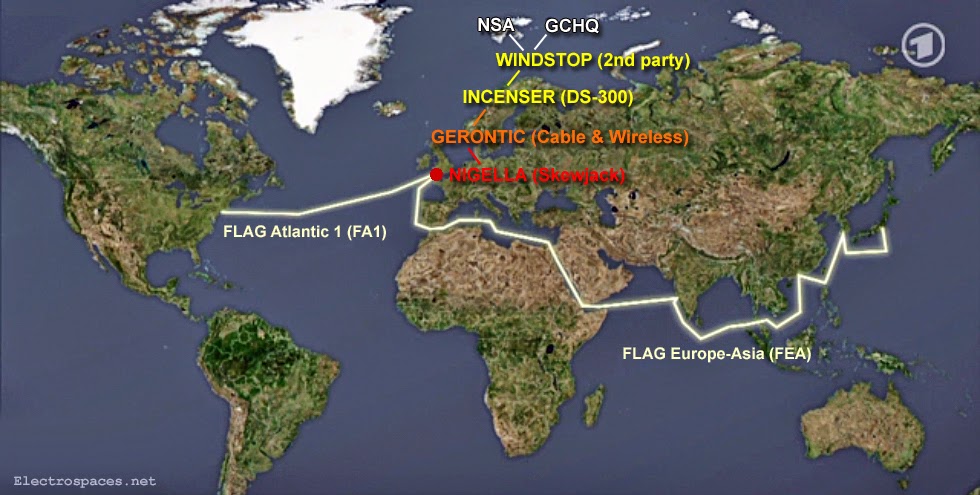
(Last edited: December 21, 2016) Recently disclosed documents show that the NSA's fourth-largest cable tapping program, codenamed INCENSER, pulls its data from just one single source: a submarine fiber optic cable linking Asia with Europe. Until now, it was only known that INCENSER was a sub-program of WINDSTOP and that it collected some 14 billion pieces of internet data a month. The latest revelations now say that these data were collected with the help of the British company Cable & Wireless (codenamed GERONTIC, now part of Vodafone) at a location in Cornwall in the UK, codenamed NIGELLA. For the first time, this gives us a view on the whole interception chain, from the parent program all the way down to the physical interception facility. Here we will piece together what is known about these different stages and programs from recent and earlier publications. - NIGELLA - GERONTIC - INCENSER - WINDSTOP - The cables tapped at NIGELLA by GERONTIC under the INCENSER and WIND...

NSA still uses the UMBRA compartment for highly sensitive intercepts

Gambar
(Updated: December 7, 2014) Three days ago, on July 5, 2014, The Washington Post published some of the most important stories from the Snowden-leaks so far. It revealed that Snowden did had access to the content of data collected under FISA and FAA authority - a fact that had been kept secret until now. I'll come back on that main story later. Here we will take a look at a remarkable detail from two slides that were also disclosed in the Post's article. The classification marking of these slides contains the codeword UMBRA, which was generally considered to be abolished in 1999, but now seems to be still in use. After going through several options, my conclusion is that UMBRA is most likely the codename of a so-called unpublished SCI control system. "Target Package" prepared by the National Security Agency prior to the capture of Abu Hamza in January 2011 (click to enlarge) These slides are from a 2011 powerpoint presentation which details the plan to capture al-Qae...